Qwen3.8-Max vs Gemini 3.1 Pro vs GPT-5.6 Sol vs Claude Fable 5: Capability, Cost and the Best Model for AI Agents
Research updated: 5 August 2026
The frontier AI market is no longer a simple contest between OpenAI, Google and Anthropic. Alibaba’s Qwen3.8-Max has entered the top tier with early results close to the strongest American models—and potentially at a much lower cost.
However, choosing a model based only on one leaderboard score is a mistake. A production AI system must also consider coding reliability, multimodal input, agent tools, context length, pricing structure, availability and operational risk.
This comparison focuses on four current frontier models:
- Qwen3.8-Max Preview from Alibaba
- Gemini 3.1 Pro Preview from Google
- GPT-5.6 Sol from OpenAI
- Claude Fable 5 from Anthropic
The conclusion first
There is no universal winner.
| Requirement | Best choice |
|---|---|
| Maximum absolute capability | Claude Fable 5 |
| Best integrated AI-agent platform | GPT-5.6 Sol |
| Best native multimodal value | Gemini 3.1 Pro Preview |
| Best potential price-performance | Qwen3.8-Max Preview |
| Best production architecture | Multi-model routing |
In simple terms:
Claude is the strongest, Qwen is the disruptive challenger, Gemini is the multimodal specialist, and OpenAI provides the most complete agent-building platform.
The correct enterprise strategy is usually not to select one model forever. It is to route each task to the model that offers the best balance of quality, cost and risk.
Capability comparison
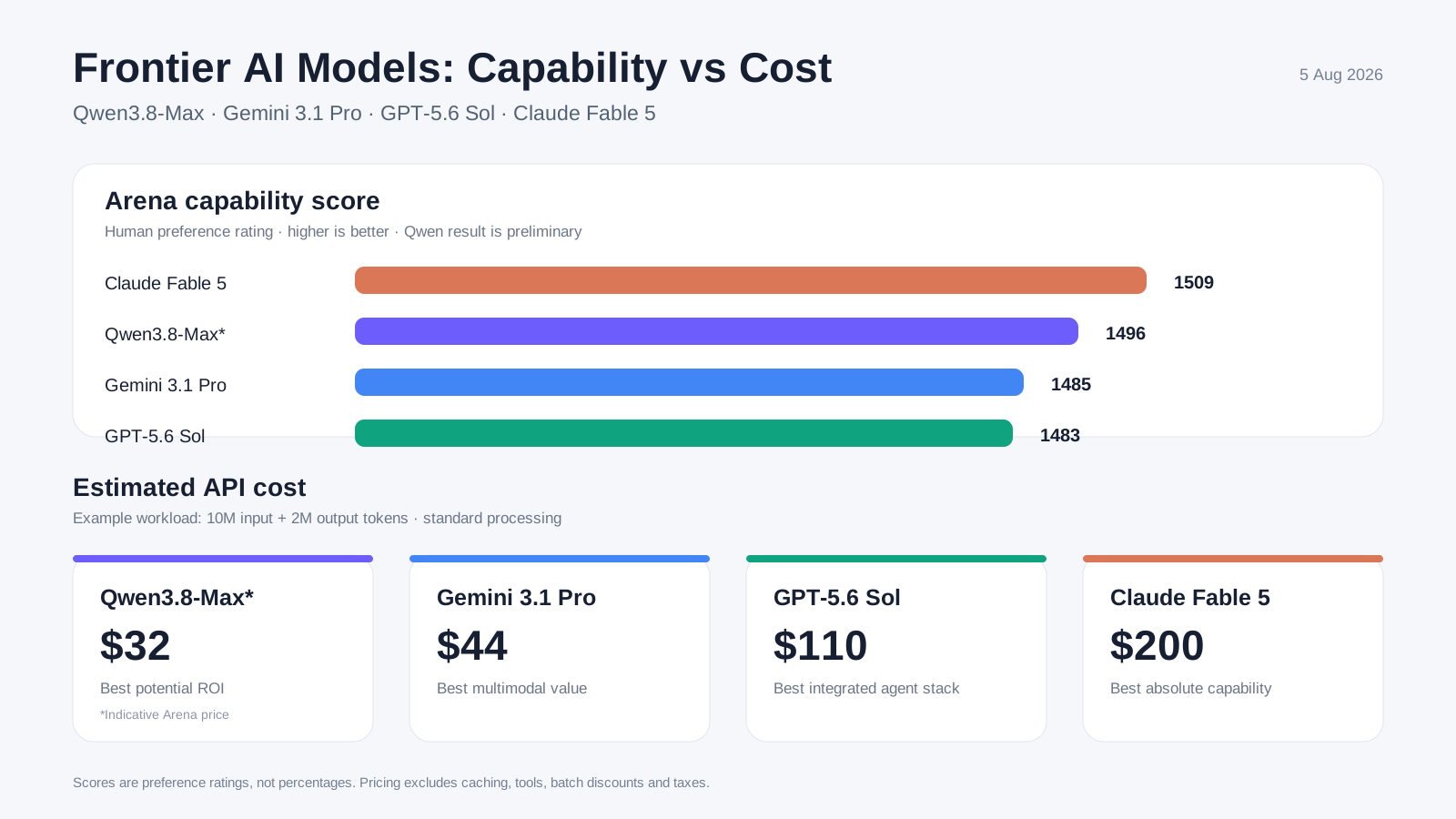
Arena evaluates models using blind human preference votes. It is useful because users compare real answers rather than only static benchmark scores.
At the time of this research, the broad capability signals were approximately:
| Model | Arena overall signal | Coding signal | Interpretation |
|---|---|---|---|
| Claude Fable 5 | Around 1509 | Frontier-leading | Strongest mature quality signal |
| Qwen3.8-Max | Around 1496, preliminary | Near-frontier, preliminary | Extremely promising but less statistically stable |
| Gemini 3.1 Pro Preview | Around 1485 | Strong but below the leaders | Mature multimodal and agentic model |
| GPT-5.6 Sol | Around 1483 | Strong frontier coding | Better platform story than its overall rank suggests |
These numbers are preference ratings, not percentages. A difference of ten or twenty points does not mean one model is ten or twenty percent better. Error ranges, vote counts and task distribution matter.
Qwen’s result deserves extra caution because it is new. Early models can move significantly as more votes arrive. Recent reporting nevertheless confirms that Qwen3.8-Max quickly became the highest-ranked Chinese text model and placed close to Anthropic’s leading systems.
Claude Fable 5: the strongest choice for difficult work
Claude Fable 5 is Anthropic’s most capable generally available model. Anthropic positions it for ambitious coding, complex migrations, long-running agents, research and multi-stage professional work.
Its main advantage is not merely producing a good first answer. It is the ability to sustain a difficult task across many steps: planning, implementing, testing, reviewing and correcting its own work.
Where Claude is strongest
- Large software engineering projects
- Architecture and difficult debugging
- Complex migrations and refactoring
- Long-horizon autonomous agents
- Research and document-heavy professional work
- High-quality writing and instruction following
Cost
Claude Fable 5 costs:
- $10 per million input tokens
- $50 per million output tokens
That makes it the most expensive model in this comparison. Nevertheless, price per token is not the same as price per completed task. A model that succeeds in one run may cost less overall than a cheaper model that requires repeated corrections.
Practical verdict
Use Claude when the cost of a wrong answer, failed implementation or repeated retry is higher than the token bill.
适合:复杂任务、长期 Agent、大型 codebase、需要 senior-engineer judgment 的工作。
Qwen3.8-Max: the most disruptive challenger
Qwen3.8-Max is important because it challenges the assumption that frontier capability must come from a closed American model at premium pricing.
Alibaba describes the preview model as supporting reasoning, visual understanding and text generation. QwenCloud integrations document a context window close to one million tokens, output of up to 131,072 tokens and reasoning support.
Its early Arena position suggests that it can compete surprisingly close to Claude, OpenAI and Google on general text tasks. Recent reporting also describes Qwen3.8-Max as a 2.4-trillion-parameter mixture-of-experts model that activates a smaller subset of parameters for each request.
Where Qwen is attractive
- Cost-sensitive coding agents
- Large-context experimentation
- Visual and text workflows
- Open-weight or self-hosting-oriented strategies
- Organizations wanting less dependence on US model providers
- Shadow testing against expensive frontier models
The pricing problem
QwenCloud currently distributes qwen3.8-max-preview primarily through a Credits-based Token Plan rather than a conventional pay-as-you-go token price.
Personal plans are advertised at limited-time monthly prices such as $6, $18 and $68, with five-hour and seven-day credit limits. Team plans use monthly credit quotas.
Arena metadata has displayed an indicative rate around $2 input / $6 output per million tokens, but this should not be treated as an official QwenCloud PAYG quotation. Credits do not translate cleanly into a universal cost per million tokens.
The preview documentation also states that the model may be taken offline or replaced when the preview period ends.
Practical verdict
Qwen may become the best value model in this group, but it is not yet the safest model to make the only dependency in a production system.
The sensible approach is to run Qwen in shadow mode: send representative tasks to Qwen and another established model, then compare task completion, latency, retries, tool-call accuracy and real credit consumption.
简单讲:Qwen 不是“便宜但差”。它可能是“很强又便宜”,但是现在 evidence 还新,production 不应该马上 all-in。
Gemini 3.1 Pro Preview: the multimodal specialist
Gemini 3.1 Pro Preview has the broadest native input support in this comparison:
- Text
- Images
- Video
- Audio
- PDF documents
It supports a 1,048,576-token input limit and 65,536 output tokens. Google also documents function calling, structured output, thinking, code execution, URL context, search grounding and Maps grounding.
This makes Gemini especially suitable for intelligent document processing, report analysis, invoice extraction, screenshots, meeting recordings and video understanding.
Pricing
For prompts up to 200,000 tokens:
- $2 per million input tokens
- $12 per million output tokens
For prompts above 200,000 tokens:
- $4 per million input tokens
- $18 per million output tokens
The long-context surcharge matters. A one-million-token window is useful, but developers should not assume that sending the maximum context is always economical or accurate.
Practical verdict
Gemini offers the best balance for document-heavy and multimodal workloads. For ERP systems, it is particularly attractive for processing PDFs, scanned documents, tables, screenshots, audio and mixed business files.
适合:IDP、PDF、invoice、report screenshot、audio、video 和 document analysis。
GPT-5.6 Sol: the most complete agent platform
GPT-5.6 Sol is OpenAI’s frontier model for complex professional work. It supports a 1,050,000-token context window, up to 128,000 output tokens, reasoning controls, text and image input, function calling and structured output.
Its strongest advantage is the surrounding platform.
OpenAI’s Responses API provides a broad set of first-party agent capabilities, including:
- Function calling
- Web search
- File search
- Code Interpreter
- Hosted shell environments
- Computer use
- MCP connectivity
- Structured outputs
- Image generation and editing workflows
A model can be excellent in isolation but still require substantial engineering to become a reliable agent. OpenAI reduces that integration burden by providing many components within one API ecosystem.
Pricing
GPT-5.6 Sol costs:
- $5 per million input tokens
- $30 per million output tokens
- $0.50 per million cached input tokens
Requests exceeding 272,000 input tokens are charged at twice the input rate and 1.5 times the output rate for the entire request. This makes careless long-context usage expensive.
Practical verdict
OpenAI is the strongest choice when the project needs a complete, integrated AI-agent system rather than only a powerful text model.
适合:MCP、tool calling、structured JSON、computer use、file search 和完整 agent workflow。
Cost simulation
Consider a monthly workload of:
- 10 million input tokens
- 2 million output tokens
- Standard real-time processing
- No cache savings
- No batch discount
- No tool charges or taxes
| Model | Estimated cost |
|---|---|
| Qwen3.8-Max | $32, indicative only |
| Gemini 3.1 Pro, prompts at or below 200K | $44 |
| GPT-5.6 Sol, prompts at or below 272K | $110 |
| Claude Fable 5 | $200 |
| Gemini 3.1 Pro, prompts above 200K | $76 |
| GPT-5.6 Sol, prompts above 272K | $190 |
The Qwen estimate uses the indicative Arena metadata rate, not the official Credits-based billing model. It should be treated as a scenario rather than a quotation.
The table also reveals an important lesson: long-context surcharges can almost eliminate an apparent price advantage. Sending an entire database schema, codebase or document collection into every request is not a good architecture.
Use retrieval, summarization, caching and task-specific context assembly instead.
Which model should an ERP AI system use?
For an enterprise ERP AI agent, I would not deploy one flagship model for everything.
A better design is a model router with four levels.
Level 1: routine business requests
Use a lower-cost model for:
- Looking up customer or product information
- Summarizing structured records
- Generating standard JSON
- Creating ordinary reports
- Simple SQL or API orchestration
Candidates include a balanced OpenAI tier, Gemini Flash or another validated low-cost model.
Level 2: documents and multimodal input
Route PDFs, invoices, screenshots, forms, audio and video to Gemini 3.1 Pro or an appropriate Gemini Flash model.
Level 3: difficult engineering and reasoning
Escalate architecture reviews, production debugging, complex migrations and long-running autonomous tasks to Claude Fable 5.
Level 4: cost optimization and experimentation
Run Qwen3.8-Max in shadow mode. Promote it gradually for task categories where it matches the established model’s success rate at lower cost.
This architecture gives the system a better combination of quality, availability and budget control than any single-model strategy.
Do not trust one leaderboard
Arena is valuable, but it measures human preference over its own prompt distribution. It does not directly measure:
- Your ERP business rules
- Tool-call correctness
- Database safety
- Structured-output validity
- Latency under your account limits
- Cost per successfully completed workflow
- Hallucination rate on your private documents
The only trustworthy final benchmark is a private evaluation set built from real tasks.
For an ERP agent, that evaluation set should include:
- Business-rule questions with known answers
- Tool calls with exact expected parameters
- Structured JSON schema validation
- Read-only database investigations
- Document extraction tests
- Multi-step workflows with failure recovery
- Cost, token and latency measurements
- Human review of the completed business result
Final ranking
Best absolute capability
Claude Fable 5
Choose it for the hardest work where reliability matters more than token cost.
Best AI-agent platform
GPT-5.6 Sol
Choose it when you need a broad, integrated tool and API ecosystem.
Best multimodal value
Gemini 3.1 Pro Preview
Choose it for PDFs, images, audio, video and document-heavy business workflows.
Best potential return on investment
Qwen3.8-Max Preview
Test it aggressively, but keep a fallback until its production pricing, availability and independent evidence mature.
Final takeaway
The frontier model race is becoming more competitive and less predictable. Qwen3.8-Max shows that high capability may no longer require premium closed-model pricing. Claude still offers the strongest mature quality signal. Gemini provides exceptional multimodal value. OpenAI offers the most complete foundation for agent engineering.
The winner for a real company is therefore not a single model.
The winning system is an evaluation-driven model router that uses the cheapest model capable of completing each task safely and escalates only when necessary.
Sources
- Arena text leaderboard
- Arena leaderboard overview
- QwenCloud Token Plan overview
- QwenCloud developer-tool model configuration
- OpenAI GPT-5.6 Sol documentation
- OpenAI model comparison
- Google Gemini 3.1 Pro model documentation
- Google Gemini API pricing
- Anthropic Claude Fable 5
- Reuters coverage of Qwen3.8-Max