SOTA Model Study 2026: Gemini 3.8 Flash vs Claude Fable 5.1 vs GPT-5.6 Sol
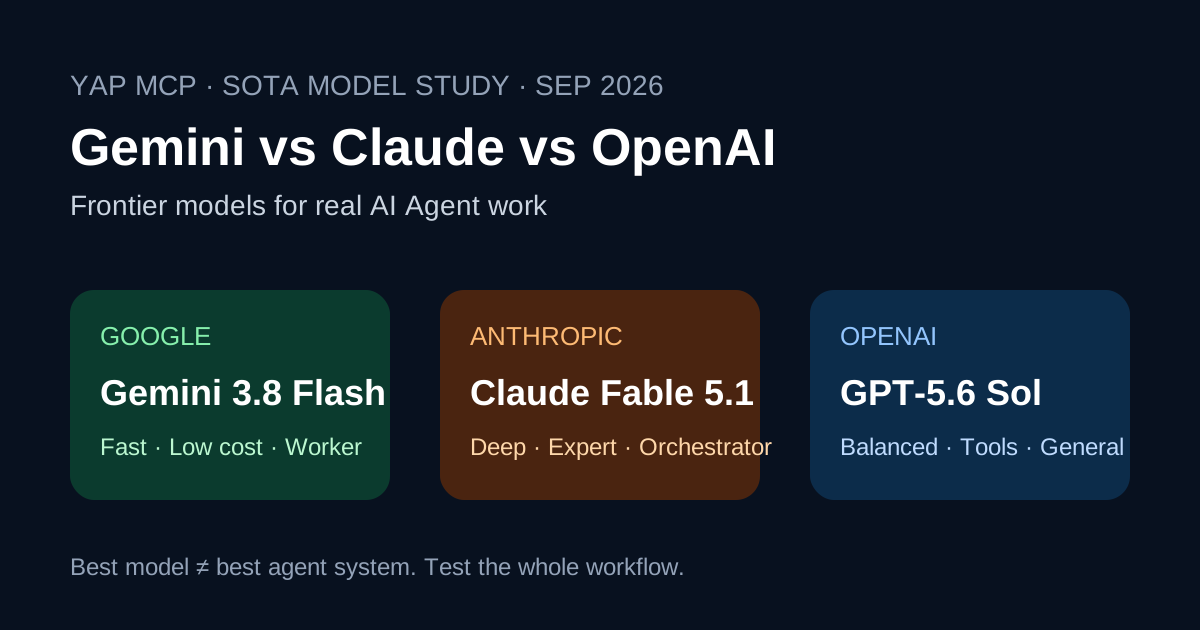
Research snapshot: September 3, 2026
The frontier AI market moved unusually fast this week. Anthropic released Claude Fable 5.1 on September 1, and Google followed with Gemini 3.8 Flash on September 2. OpenAI's current flagship remains GPT-5.6 Sol, released publicly in July and updated with lower API pricing in August.
Instead of asking a vague question such as “Which model is best?”, this study asks a more useful engineering question:
Which model is best for which job — and which complete AI Agent system delivers the best successful outcome per dollar, per minute, and per attempt?
That distinction matters. A model can lead a benchmark and still be a poor default for a high-volume production Agent. A cheaper model can lose on raw intelligence yet win the actual workflow because it is fast, reliable and inexpensive enough to retry or parallelize.
Executive summary
My current Phase 1 conclusion is simple:
- Claude Fable 5.1 is the current raw-intelligence leader in the independent Artificial Analysis Intelligence Index at max effort.
- Gemini 3.8 Flash is the strongest price-performance surprise: high frontier capability, very high output speed and much lower token pricing.
- GPT-5.6 Sol sits between them as a strong general-purpose frontier model with a mature tool ecosystem, large context window and more moderate pricing than Fable 5.1.
- There is no honest overall winner yet for coding Agents. Agent harness, benchmark version, tool policy, retries and reasoning settings can materially change the result.
The three models at a glance
| Metric | Google Gemini 3.8 Flash | Anthropic Claude Fable 5.1 | OpenAI GPT-5.6 Sol |
|---|---|---|---|
| Current role | Fast frontier workhorse | Deep reasoning / expert model | General-purpose flagship |
| Artificial Analysis Intelligence Index | 59 at high | 66 at max | 61 at max |
| Context window | 1M | 1M | 1.05M |
| Input price / 1M tokens | $0.75 introductory | $10 | $4 promotional |
| Output price / 1M tokens | $3.75 introductory | $50 | $20 promotional |
| AA output speed | ~300 tok/s at high | Lower than Gemini | Standard Sol is much slower than Gemini; separate Ultrafast tier can be far faster |
| Multimodal input | Text, image, video, speech | Text, image | Text, image |
| Function / tool calling | Yes | Yes | Yes |
| Structured output | Yes | Yes | Yes |
| Long-horizon Agent focus | Strong | Very strong | Very strong |
| Current practical strength | Speed + cost | Deep reasoning + knowledge work | Balance + tools + ecosystem |
These numbers are a dated snapshot, not permanent rankings. Prices, model revisions and benchmark methodologies can change quickly.
1. Gemini 3.8 Flash: the speed and economics play
Google describes Gemini 3.8 Flash as its best reasoning and coding model yet and its most intelligent workhorse model. It is specifically aimed at software engineering, autonomous Agents and multi-step reasoning.
The current introductory API price is only $0.75 per million input tokens and $3.75 per million output tokens. Artificial Analysis reports an Intelligence Index score of 59 at high reasoning, with a cost of about $0.58 per Intelligence Index task and roughly 300 output tokens per second.
What is especially interesting is where the improvement came from. Artificial Analysis says the gain over Gemini 3.7 Flash is primarily driven by agentic evaluations including tool use, Terminal-Bench coding and real-world task benchmarks.
That makes Gemini 3.8 Flash particularly attractive for:
- high-volume worker Agents;
- repeated tool-calling loops;
- search, classification and extraction workers;
- parallel sub-agents;
- coding tasks where latency matters;
- workloads where cost per successful task matters more than winning every benchmark.
The main caution is freshness. The model was released only one day before this study snapshot, so independent evidence is still relatively limited.
2. Claude Fable 5.1: the deep-reasoning leader
Anthropic positions Claude Fable 5.1 as a new frontier for coding, knowledge work and long-running problem solving.
Artificial Analysis currently measures 66 at max effort, the highest Intelligence Index score it has measured. It also reports very strong agentic knowledge-work performance. At max effort, however, Fable 5.1 costs around $3.76 per Intelligence Index task in that evaluation.
Standard token pricing remains $10 per million input tokens and $50 per million output tokens. Anthropic has substantially reduced cache-read pricing, which can make a large difference for context-heavy Agent loops, but the model is still a premium option.
This suggests a useful production role:
- difficult root-cause analysis;
- long-running research;
- hard coding tasks;
- complex planning;
- final review or verification;
- expert / orchestrator Agent where quality matters more than raw throughput.
One benchmark caveat is important: Artificial Analysis evaluated Fable 5.1 with Anthropic's default server-side fallback, which served a small portion of output tokens. So some leaderboard numbers should be understood as a model-system result rather than perfect model isolation.
3. GPT-5.6 Sol: the balanced professional Agent
OpenAI describes GPT-5.6 Sol as its flagship model for complex professional work, with support for reasoning from none through max.
The current API documentation lists:
- 1,050,000-token context window;
- 128,000 maximum output tokens;
- function calling;
- structured outputs;
- web search;
- file search;
- computer use;
- image input;
- current promotional pricing of $4 input / $20 output per million tokens.
Artificial Analysis currently places GPT-5.6 Sol max at 61 on its Intelligence Index. This is below Fable 5.1 max but above Gemini 3.8 Flash high in the same current comparison.
Sol's interesting position is not simply “second place.” It offers a more moderate cost profile than Fable, strong professional-task capability, low token use relative to several models of similar intelligence, and a mature Agent/tooling ecosystem through the OpenAI Responses API and Codex.
That makes it a strong candidate for:
- general enterprise Agents;
- coding and implementation;
- research with native tools;
- ERP copilots;
- MCP orchestration;
- computer-use workflows;
- workflows where one model needs to cover many different task types.
Why coding benchmarks are easy to misuse
A major lesson from this study is that benchmark version matters.
When GPT-5.6 launched in July, Artificial Analysis reported GPT-5.6 Sol in Codex leading its Coding Agent Index with a score of 80 under the methodology used at that time. The benchmark and comparison environment have since evolved, while newer models such as Claude Fable 5.1 and Gemini 3.8 Flash have only just arrived.
It would be misleading to combine scores from different dates, benchmark versions, harnesses and reasoning settings and then claim one permanent coding champion.
For Agent systems, the unit of evaluation should be:
Model + harness + tools + prompt + context + retry policy + timeout + acceptance test
—not just the model name.
The architecture hypothesis I want to test
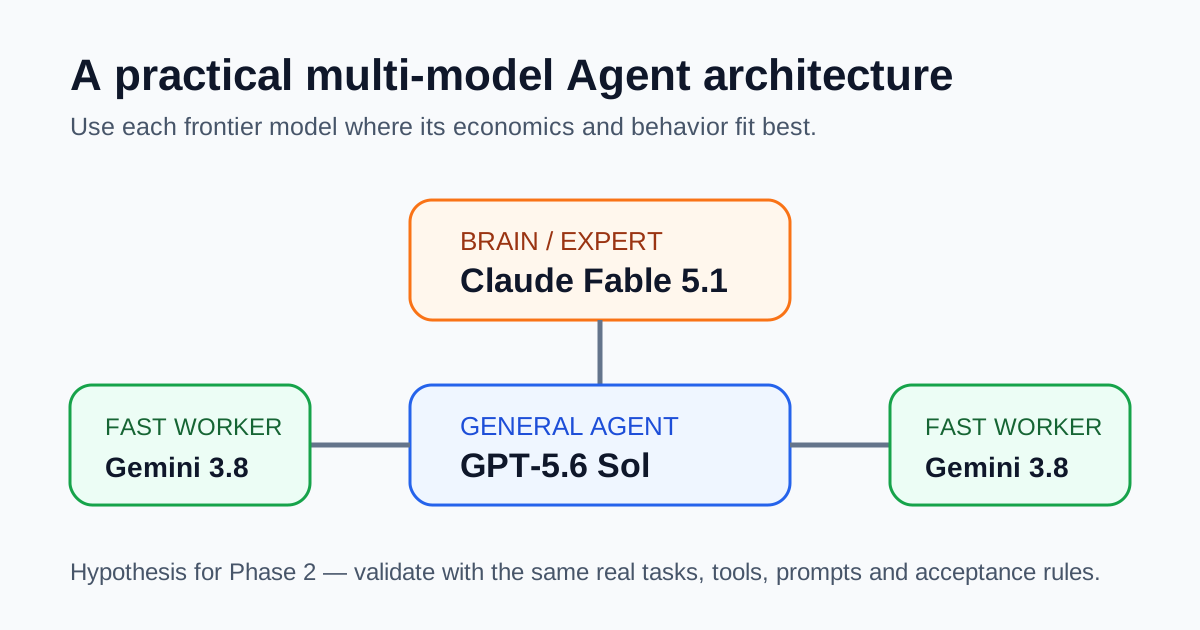
Instead of forcing one model to do everything, a practical multi-model Agent system may look like this:
Claude Fable 5.1 → Brain / Expert / difficult reviewer
Use the expensive model selectively when deep analysis, long-horizon reasoning or complex verification is justified.
GPT-5.6 Sol → General Agent / Orchestrator
Use it for broad professional workflows, tool orchestration, coding, research and enterprise interaction.
Gemini 3.8 Flash → Fast Worker
Use it for parallel tasks, repeated tool loops, extraction, search, coding subtasks and high-volume execution.
This is only a hypothesis, not a conclusion. Phase 2 must test it.
Phase 2: our real-world benchmark
The next phase will move beyond public leaderboards.
The plan is 30 real-world tasks × 5 repeated runs per model using the same task fixtures and comparable settings.
The task set will include:
- Coding implementation
- Debugging and root-cause analysis
- PostgreSQL and ERP business reasoning
- MCP / tool selection
- AI Agent planning
- Structured JSON and tool arguments
- Web research and grounding
- Long-context repository understanding
- Ambiguous and no-answer cases
- Failure recovery after a tool or validation error
We will freeze the important variables:
- prompt;
- context;
- available tools;
- output schema;
- timeout;
- retry policy;
- evaluation rubric;
- acceptance tests;
- reasoning-effort mapping.
And we will measure more than benchmark accuracy:
- accepted task success;
- correctness;
- grounding;
- hallucination / unsupported claims;
- tool argument validity;
- schema validity;
- recovery behavior;
- repeat stability;
- p50 and p95 latency;
- token use;
- error rate;
- cost per successful task.
A second track should test the native Agent stacks separately — for example Codex, Claude Code and Google's relevant coding/Agent environment — because the best base model may not produce the best complete Agent system.
Current recommendation
If I had to choose today, before our own Phase 2 results:
| Need | Current candidate |
|---|---|
| Maximum raw reasoning | Claude Fable 5.1 |
| Lowest cost at strong frontier capability | Gemini 3.8 Flash |
| Fast high-volume workers | Gemini 3.8 Flash |
| Premium expert / reviewer | Claude Fable 5.1 |
| Broad general-purpose Agent | GPT-5.6 Sol |
| ERP / MCP Agent | GPT-5.6 Sol vs Gemini 3.8 Flash — test it |
| Coding Agent champion | Unresolved — same-harness test required |
The important conclusion is not that one company has won.
The frontier is becoming specialized. The more useful engineering question is how to route work to the right model and prove the routing with real task outcomes.
中文简评
简单讲:
- Claude Fable 5.1:目前最像高价的 senior expert,复杂 reasoning、research、long-running task 很值得测试。
- Gemini 3.8 Flash:现在最大的亮点是 快 + 便宜 + 已经很聪明,很适合大量 worker agents。
- GPT-5.6 Sol:不是每项都第一,但整体比较 balanced,tool ecosystem 和 enterprise Agent 使用方式很成熟。
所以我现在比较想验证的不是“三选一”,而是:
Claude 做 Brain,GPT 做 General Agent,Gemini 做 Fast Worker,会不会比只用一个模型更好?
这就是 Phase 2 要用真实 coding、ERP、MCP、research tasks 来回答的问题。
Sources
Official sources:
- Google — Gemini 3.8 Flash: https://blog.google/innovation-and-ai/models-and-research/gemini-models/3-8-flash-and-3-8-flash-cyber/
- Anthropic — Claude Fable 5.1 and Mythos 5.1: https://www.anthropic.com/claude-fable-and-mythos-5-1
- OpenAI — GPT-5.6 Sol API model documentation: https://developers.openai.com/api/docs/models/gpt-5.6-sol
- OpenAI — GPT-5.6 launch: https://openai.com/index/gpt-5-6/
Independent benchmark sources:
- Artificial Analysis — Gemini 3.8 Flash: https://artificialanalysis.ai/articles/gemini-3-8-flash
- Artificial Analysis — Claude Fable 5.1: https://artificialanalysis.ai/articles/claude-fable-5-1
- Artificial Analysis — GPT-5.6: https://artificialanalysis.ai/articles/gpt-5-6-has-landed
Research note: This article is a dated September 3, 2026 snapshot. Model APIs, pricing, benchmark versions and performance can change. Phase 2 will update the conclusions using controlled repeated real-world tests rather than relying on a single leaderboard.